
2026 Exhibitors
Exhibitor Zones
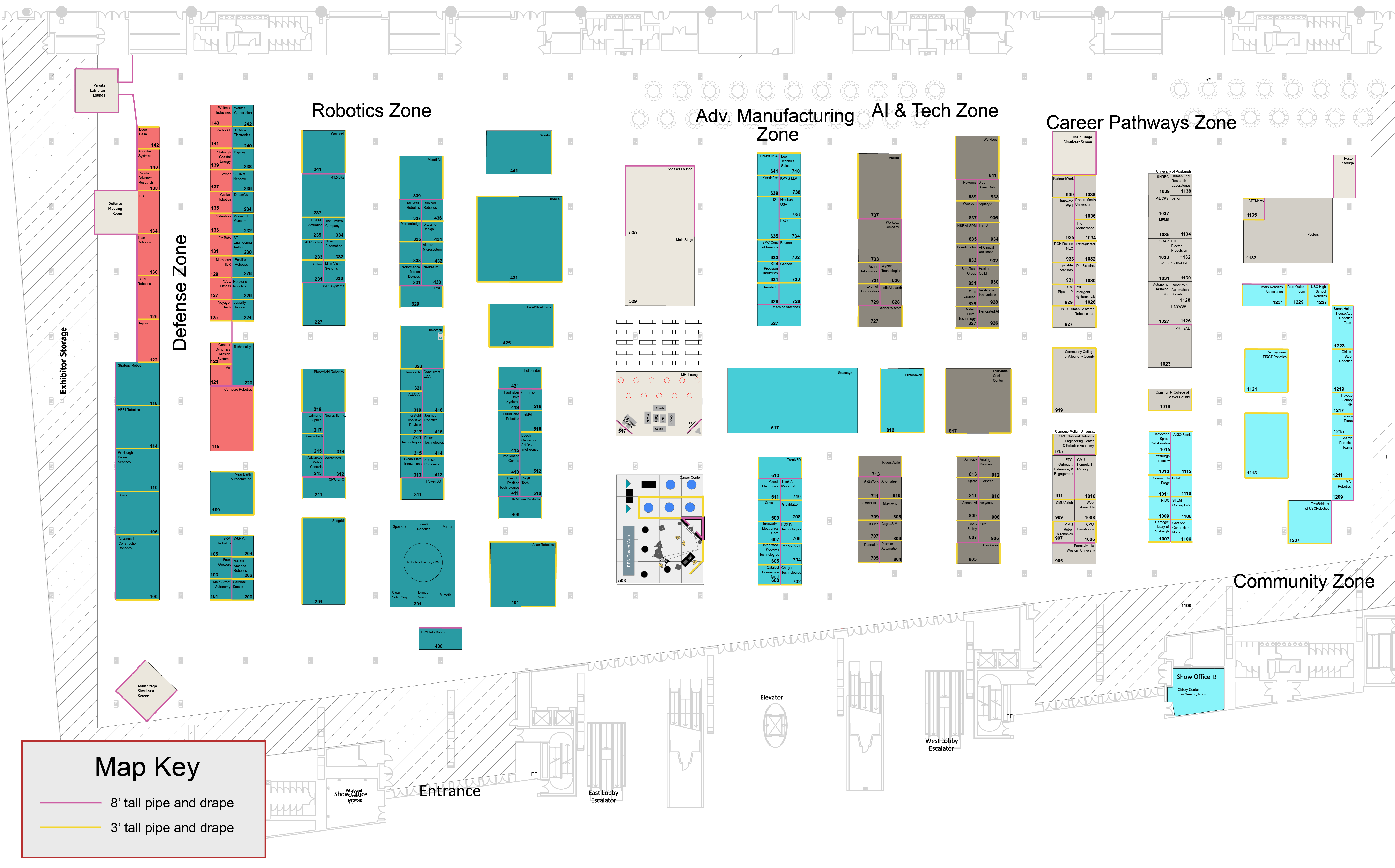
Career Pathways

AirLab, Carnegie Mellon University
AirLab's mission is to advance state-of-the-art autonomy. We are proud to be part of the Robotics Institute at Carnegie Mellon University.

CMU Biorobotics Lab
CMU Biorobotics Lab
Operating within Carnegie Mellon University’s Robotics Institute, the Biorobotics Lab specializes in bio-inspired mechanisms, modular robotics, and articulated snake robots. Co-directed by Dr. Howie Choset and Dr. Matthew Travers, the lab designs multi-jointed systems capable of threading through dense clutter, climbing structures, and navigating narrow channels. Their research advances state estimation, motion planning, and human-robot interaction across applications in urban search and rescue, surgical procedures, nuclear decommissioning, and infrastructure inspection.

CMU Entertainment Technology Center (OEEE TEAM)
Higher Ed / University

CMU National Robotics Engineering Center (NREC)
CMU National Robotics Engineering Center (NREC)
The Carnegie Mellon University National Robotics Engineering Center brings 30 years of experience to bridge the gap between fundamental research and commercial technology by developing and deploying custom robotic solutions for industry partners and government sponsors.
The Carnegie Mellon Robotics Academy studies how educators can use robots to teach Computer Science, Science, Technology, Engineering, and Mathematics (CS-STEM). Our mission is to use the educational affordances of robotics to create CS-STEM opportunities for all learners. We fulfill our mission by developing research-based solutions that are classroom-tested and foreground CS-STEM concepts.

CMU Robomechanics Lab
CMU Robomechanics Lab
Operating within Carnegie Mellon University’s Department of Mechanical Engineering and the Robotics Institute, the Robomechanics Lab studies the physical mechanics of robot-environment interactions. Led by Dr. Aaron Johnson, the lab develops novel mechanism designs, hybrid control algorithms, and perception frameworks for legged platforms, climbing robots, and autonomous off-road vehicles. Their research focuses on enabling robots to reliably navigate hazardous, unstructured environments ranging from steep cliffs and underbrush to planetary surfaces and collapsed structures.
CMU Robotics Academy
The Carnegie Mellon University National Robotics Engineering Center brings 30 years of experience to bridge the gap between fundamental research and commercial technology by developing and deploying custom robotic solutions for industry partners and government sponsors.
The Carnegie Mellon Robotics Academy studies how educators can use robots to teach Computer Science, Science, Technology, Engineering, and Mathematics (CS-STEM). Our mission is to use the educational affordances of robotics to create CS-STEM opportunities for all learners. We fulfill our mission by developing research-based solutions that are classroom-tested and foreground CS-STEM concepts.

Community College of Allegheny County
The Community College of Allegheny County (CCAC) is a regional leader in robotics, advanced manufacturing, and industrial automation education, preparing students for careers in one of Pittsburgh's fastest-growing technology sectors. Through hands-on certificate and degree programs, industry-recognized credentials, apprenticeships, and workforce training, CCAC equips learners with practical experience using industrial robots, collaborative robots, PLCs, machine vision, automation systems, and smart manufacturing technologies. Working closely with employers across Western Pennsylvania, CCAC helps develop the skilled workforce that powers the region's manufacturing, logistics, energy, and technology industries while providing accessible pathways for students, career changers, and working professionals to enter and advance in robotics-related careers.

Community College of Beaver County
Community College of Beaver County (CCBC) drives Western Pennsylvania’s technical workforce by preparing students for high-demand careers in robotics, artificial intelligence, and advanced technology.
STEM & Robotics Education
CCBC offers industry-aligned degrees, micro-credentials, and hands-on technical training designed alongside regional industry leaders. Students learn troubleshooting, automation, programming, and system maintenance directly in modern lab environments.
College in High School & Early Pathways
Through the CCBC STEM Academy and dual enrollment programs, high school juniors and seniors earn up to 28 college credits before graduation. Students jumpstart careers in engineering, robotics, cybersecurity, and computer science while cutting the time and cost to complete a degree.
Workforce & Career Pathways
Whether aiming to step directly into tech roles or transfer seamlessly to a four-year university, CCBC builds practical skills that match regional workforce needs.

DLA Piper
With a portfolio of services to match every stage of the business lifecycle, DLA Piper combines practice area knowledge with modern industry insights and an expansive global footprint in a way that no other firm can. Our solutions are tailored and seamless – and ready to meet your toughest challenges. We’re guided by a simple belief – that we’re only as successful as our clients are. That’s why we fully invest in your success by working with you to deliver creative solutions, exceptional value, and peace of mind.
DLA Piper has more than 90 offices and 4,900 lawyers worldwide. Our deep capabilities and broad global platform and mind-set produce exceptional results for our clients around the world. In the US, we are located in all key markets and offer a full range of services. We represent many of the world's leading companies, including multinational, Global 1000 and FTSE 250 companies, in a wide range of industries.

Dora Rudick/Coldwell Banker Realty
Dora Rudick is top real estate professional in the city of Pittsburgh, servicing home buyers and sellers within the city and suburbs.

Equitable Advisors
Equitable Advisors is a leading financial services firm that helps individuals, families, businesses, and organizations navigate retirement planning, investments, insurance, employee benefits, and wealth management. Through personalized guidance and education, we help clients make informed financial decisions and work toward a more secure future.

HNSWSR: Highly Non-linear Solitary Wave Sensing Robot
HNSW is a nondestructive evaluation (NDE) technique for identifying localized corrosion in metallic structures. Integrating this method with a robotic platform enables portability and automation for Structural Health Monitoring (SHM). The robot's navigation system consists of four encoder motors, a gyroscope, and a 3-dimensional accelerometer, which together provide odometry for self-localization. During operation, a host computer visualizes the captured waveforms in real time.

Human-Autonomy Teaming (HAT) Lab
Operating within the University of Pittsburgh’s Department of Informatics and Networked Systems, the Human-Autonomy Teaming (HAT) Lab researches interactions between human operators and intelligent autonomous agents. Led by Dr. Na Du, the lab combines data-driven computational modeling with theory-driven human factors engineering to evaluate situational awareness, trust in automation, and operator cognitive load. Their work spans automated driving, urban mobility, healthcare robotics, and military human-agent teaming applications.
Human Engineering Research Laboratories
"HERL is a research center affiliated with the University of Pittsburgh and the VA Pittsburgh Healthcare System, dedicated to advancing assistive technology and rehabilitation engineering for individuals with disabilities. The assistive mobility robots will demonstrate advancements in autonomous obstacle navigation and robotic arm manipulation for daily tasks, highlighting the intersection of user-centered design, assistive robotics, and physical AI."

InnovatePGH
InnovatePGH is a non-profit organization focused on translating Pittsburgh's significant technological strengths into an equitable growth strategy. Through customized founder support, direct programming, and physical asset development, InnovatePGH is working to strengthen Pittsburgh's innovation district and create a founder-first neighborhood in Oakland.

MEMS - Intro to Robotics Course
As a student at the University of Pittsburgh you have the opportunity to get involved in different technical electives and special topics courses. One such course showcased here is the Introduction to Robotics class where students are exposed to an overview of robotics concepts. Students learn the basics of open source robotics software, how to program robots, sensing, communication, planning, and actuation functions to perform tasks. Talk to these senior undergrads to understand what student life is like in the MEMS department.
OAFA/Swanson Recruitment - University of Pittsburgh
Stop by the University of Pittsburgh's Office of Admissions and Financial Aid table to learn about the admissions process and our Swanson School of Engineering and School of Computing and Information programs!


PathQuester
PathQuester is a digital career education platform that simplifies career exploration and planning by offering interactive, digital job guides and AI tools. We help individuals explore and succeed in diverse pathways, whether through university degrees, trade certifications, or freelancing.

Research laboratory at Penn State University focused on Automation, Intelligent Systems, and Smart Manufacturing.

Penn State University's Human Centered Robotics Lab
The Human-Centered Robotics Lab's esearch focuses on computational methods in human-machine interaction, robot learning from demonstration, and haptics, with applications in neuroscience, health science, robotics, and robot learning. Example applications include assistive exoskeleton control, information-based haptic feedback, and robot learning from multimodal human feedback.
Pennsylvania Western University
PennWest’s story spans more than 170 years.California, Clarion, and Edinboro each opened their doors in the 1800s to students seeking opportunity through education. Across generations, these universities shaped leaders, educators, artists, innovators, and change-makers — building strong traditions of academic excellence and community impact.In July 2022, these three proud institutions came together to form PennWest University — a forward-thinking, student-centered university designed to meet the needs of today’s learners while honoring the history and identity of each campus.Today, PennWest serves students across Pennsylvania and beyond through campuses in California, Clarion, Edinboro, and a comprehensive Global Online presence. As one university with distinct campus identities, we offer a unified, high-quality educational experience rooted in flexibility, access, and real-world relevance.

Per Scholas
Per Scholas - No-cost IT training, professional development, and employer connections.
.png)
Pitt Cyber Physical System (Pitt CPS)
The Pitt CPS is a research lab in the School of Computing and Information at the University of Pittsburgh. It investigates the safety, security and sustainability of cyber-physical systems (CPS) that underpin critical infrastructure such as power grids and IoT systems. Our research examines how modern AI and machine learning techniques can both threaten and protect these systems. We study how adversaries can exploit learning-based components and we develop robust detection and mitigation methods to keep CPS resilient against such attacks.

Pitt Electric Propulsion
Pittsburgh Electric Propulsion is a student-led electric boat racing club at Pitt that gives university students a hands on experience in maritime EV's and autonomous watercraft technology.

Pittsburgh Regional Alliance / New Economy Collaborative
The Allegheny Conference on Community Development and its affiliates - the Pittsburgh Regional Alliance and the New Economy Collaborative - bring together business, civic, and community leaders to foster the conditions that enable companies to locate, grow, and invest in Southwestern Pennsylvania.
.jpg)
Pitt Society of Astronautics and Rocketry (SOAR)
SOAR - the University of Pittsburgh's chapter of Students for the Exploration and Development of Space (SEDS). Our team competes in the annual International Rocket Engineering Competition (IREC), hosted by the Experimental Sounding Rocket Association (ESRA) in the SRAD 30k Solids category. The team is composed of students from a wide range of engineering disciplines, organized into four sub-teams: propulsion, avionics, payload, and aerostructures. Students have the ability to learn about rocket design, construction, electronics, and business relations through processes. We aim to provide students with rocket engineering experience to help inspire and prepare them to have future success in the aerospace and rocketry field.

Robert Morris University
Robert Morris University (RMU) is a professionally focused, private, doctoral-granting institution dedicated to meeting local, regional, and global workforce demands. Through robust programs in Engineering & Computer Science, Computer Information Systems, Health Professions, and Business, RMU directly aligns its curriculum with industry needs. By combining strong theoretical knowledge and technical expertise with career competencies—including critical thinking, communication, teamwork, and leadership—RMU prepares well-rounded graduates for high-impact careers and serves as a preferred strategic partner for corporations across the region and beyond.

Robotics and Automation Society
We are the Pitt Robotics and Automation Society (RAS), a student-led club dedicated to giving members practical experience in robotics. We organize technical workshops, industry tours, and have four active projects: combat robots, micromouse, rover, and a robotic arm. Our teams participate in competitions like the NHRL, University Rover Challenge, and micromouse events.

SailBot Pitt
SailBot at Pitt is a club that specializes in building a small autonomous sailboat as a part of the International Robotic Sailing Regatta, competing every summer.

SHREC
The NSF Center for Space, High-Performance, and Resilient Computing (SHREC) is a consortium comprised of over 30 university, agency, industry, and institute partners working collaboratively on advanced research and workforce development in mission-critical computing and systems, from spacecraft to supercomputers.

StemNetX
We are a nonprofit focused on workforce development in emerging STEM fields

The Motherhood
The Motherhood is a women-owned marketing agency that has spent 20 years helping organizations harness the power of authentic human voices. At Robotics and AI Discovery Day, we’re showcasing Groundwork EGC, our employee-generated content platform and training approach designed to help organizations turn employees and internal stakeholders into confident, effective brand storytellers. As AI makes content creation easier and more accessible, the human voice has never been more valuable. Groundwork helps organizations create the structure, training, guardrails and strategy needed to encourage authentic content while protecting brand consistency. The result is a scalable employee advocacy program that strengthens visibility, trust, recruitment, thought leadership and brand reputation, while keeping people at the center of the story.
The University of Pittsburgh Formula Society of Automotive Engineers (FSAE) is a student led organization that designs, builds, tests, and races an open wheel formula-style racecar against universities from around the world.

VITAL: Virtual Interface for Tangibly Accessible Learning
VITAL is a fully teleoperated robot arm system designed to give students without lab access the ability to perform experiments from anywhere in the U.S. Using a VR headset and controllers, a user’s hand motions map directly to the robot arm while head tracking drives a servo-mounted camera for immersive first-person vision. The system runs on custom hardware and is mounted to a custom engineered mobile cart, providing smooth motion with low round-trip latency for both VR streaming and robotic control.
This website was prepared by SWPA New Economy Collaborative using Federal funds under award 01-79-15316 URI 121596 from U.S. Economic Development Administration, U.S. Department of Commerce. The statements, findings, conclusions, and recommendations are those of the author(s) and do not necessarily reflect the views of the U.S. Economic Development Administration or the U.S. Department of Commerce.